Sachin Tendulkar was dismissed 6 times, immortalized at Lord’s, took 6/27 in 83 all-round matches: India’s nemesis who retired at the age of 30


There are spells that survive because of the archer, and there are other spells that survive because of what they did to the opposition. Mohali in October 1999 categorically belongs to the second category. India, batting at home with Sachin Tendulkar, Rahul Dravid and Sourav Ganguly in the side, were bundled out for 83. Five batsmen made ducks. The lead destroyer returned 6 for 27.
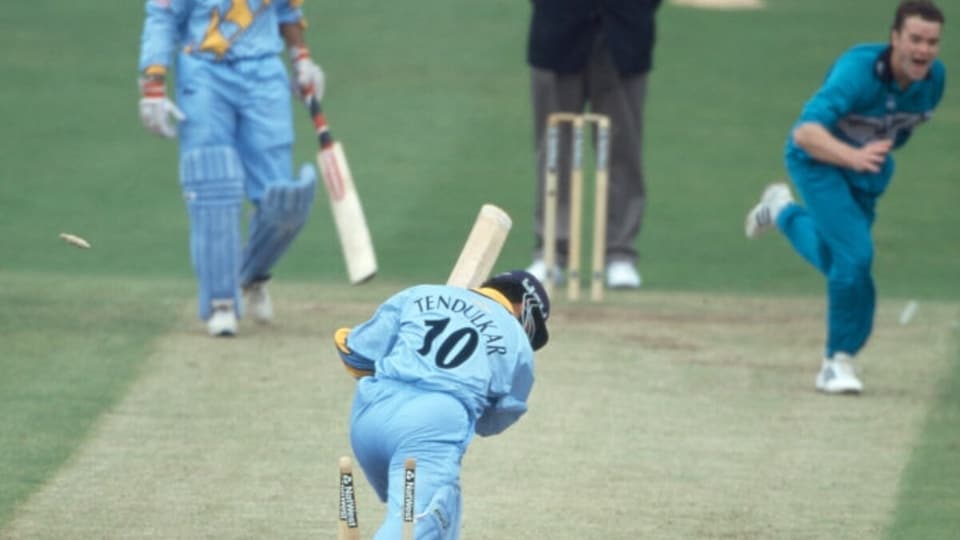
This was not even his first act of obstructionism against India. Four years ago, he had dismissed Tendulkar for four in Bangalore. In New Zealand, he would remove it again a century later. In the 1999 World Cup, where India needed victory to keep their campaign alive, he bowled Tendulkar for 16 runs as New Zealand advanced and India headed home.
The cricketer was Dion Nash, one of those cricketers whose career figures now seem too modest for the number of significant matches in which he left his fingerprint.
The New Zealander who kept finding Tendulkar
Nash W Tendulkar They were rivals for most of the 1990s, and Nash dismissed the Indian great six times in international cricket – three times in Tests and three times in ODIs. This is what makes the destruction of Mohali more than just an isolated great spell. India was an opponent that Nash repeatedly found ways to hurt.
His first Test tour of India came in 1995. In Bangalore, he removed Sanjay Manjrekar, Tendulkar and Vinod Kambli in the same innings. Four years later, when India traveled to New Zealand, Nash’s influence expanded beyond the ball.
At Wellington, he produced the best Test innings of his career, an unbeaten 89 from the lower order after India made 208. Then, when Tendulkar threatened New Zealand with a second innings hundred, Nash dismissed him for 113 and finished with 3 for 20. New Zealand won by four wickets. He followed it up with 63 at Hamilton. Across the two Tests leading up to play in that series, Nash scored 174 runs and was dismissed just once.
There was another Indian contact hidden in Sharjah. In 1998, with Sourav Ganguly Nash made 105, returning 4 for 38 – the best ODI figures of his career. That championship would eventually be swallowed up by Tendulkar’s Desert Storm legend, but Nash left his own mark on it.
Then came the World Cup. India entered their Super Six meeting with New Zealand at Trent Bridge in June 1999 needing a win to reach the semi-finals. Tendulkar returned to the tournament after his father’s death and has already produced one of the most emotional innings of his career against Kenya. But against New Zealand, Nash broke down the defense for 16 points. India made 251 points for six. New Zealand chased it down and moved on to the semi-finals. Four months later, Nash met India again. This time, in Mohali, the damage was considerably more brutal: 6 for 27, India 83rd overall.
The work of the Lord that continues
For Indian audiences, these shows provide a natural path to Nash’s story. But they don’t fully explain how good it can be. Five years before Mohali, Nash produced an exceptional all-rounder at Lord’s against England. He made 56 with the bat and then took 6 for 76 and 5 for 93, completing match figures of 11 for 169.
This combination was historic. Nash became the first player to score a fifty and take ten wickets in the same Test at Lord’s – a feat that remains extremely rare and gives a sense of the all-round ability hidden behind his relatively short career.
At his peak, Nash was much more than a backup seamer. He can move the ball, maintain pressure and contribute seriously with the bat. In 1999, the same year Tendulkar and Mohali were dismissed for six in the World Cup, he took 17 wickets. New Zealand It beat England 2-1 away from home. He finished his Test career with 93 wickets at 28.48 and 729 runs, including four half-centuries. These are respectable numbers. They also leave feeling that there should have been many more of them.
A profession that his body would not allow
Nash played just 32 Tests despite an international career that spanned from 1992 to 2002. The culprit was injuries, particularly a serious back problem that repeatedly kept him out of cricket. At one point, the underlying problem was eventually determined to be a collapsed disk. The rehabilitation process allowed him to return, but his body kept demanding to restart again. That cycle eventually became too much.
Nash retired from international cricket in 2002 when he was just 30, an age at which the all-rounder would have entered the final, substantive phase of his career. It helps explain why his name declined. New Zealand cricket of this period is more commonly remembered Richard Hadley Before him and then through Chris Cairns, Daniel Vettori and the generation that followed.
However, Indians fans have several reasons to remember Dion Nash. He took six wickets as India collapsed for 83 at home. The best ODI figures of his career came against them. He helped round out the 1999 World Cup campaign. Through repeated encounters with perhaps the defining batsman of his generation, Nash achieved something that few bowlers can claim with any regularity: he went on to get Sachin Tendulkar out. The career probably only lasted 32 Tests. Against India, she left a much bigger mark.


