
The 8,800-pound (4,000 kg) Falcon 9 rocket stage slammed into the moon last Wednesday (August 5), kicking up lunar regolith into a huge plume of dust that can be observed all the way from Earth.
The rocket joined about 3,000 man-made objects scattered on the surface of our planet’s companion. Some experts believe it’s time to start tackling the pristine lunar environment With a little more respect.
About 200 tons of ground objects were left behind or intentionally collided with the moon Since the beginning of the space age. Some of these materials have a prominent place in history books: the lineage units of the six Apollo Landing missions and Soviet Lunakhod vehicles from the 1970s-2000s in China Yuto 1 Two robots are still sitting where they were left or have run out of power.
But there’s also a lot of stuff on the moon that wasn’t supposed to end up there. Astronomer and space historian Jonathan McDowell says many rocket stages and other objects were left in orbit between them land The moon may have ended up on gray dirt since the first lunar missions in the 1960s. Four years ago The upper stage of the Falcon 9 rocket crashed Near Einstein Crater, for example, part of A Chinese Long March 3C The rocket hit the far side of the moon. Experts believe that such incidents could become increasingly common in the coming years, as lunar exploration intensifies.
“We are in a transitional moment,” McDowell told Space.com. “Since the era when lunar exploration was rare and mostly carried out by the United States and the Soviet Union, over the past decade we have seen other countries land on the moon and The beginning of trade missions. But the administration did not keep up with this. We don’t have a set of international agreements about how to operate near the Moon, how to coordinate activities near the Moon, and we’re really going to need them because, not only is the amount of activity on the Moon increasing, but A number of different players “It’s also increasing dramatically.”
Human activities on the Moon are governed by 1967 United Nations resolutions Outer Space TreatyMarita Valdivia Lefort, policy officer at the UK’s Royal Astronomical Society, told Space.com. She added that Article Nine of that treaty obligates states “to conduct exploration of outer space in a manner that avoids harmful pollution.” She added that exactly what this pollution constitutes is unclear.
“There are international legal frameworks that apply to activities on the Moon and include obligations regarding harmful pollution, but there is no dedicated international ‘waste law’ or comprehensive ‘litter management’ system for this,” Lefort wrote in an email. “The Outer Space Treaty does not specify when pollution becomes ‘harmful.’ It does not set numerical limits for waste, does not establish approved waste disposal sites, and does not require the removal of every object on the Moon.”
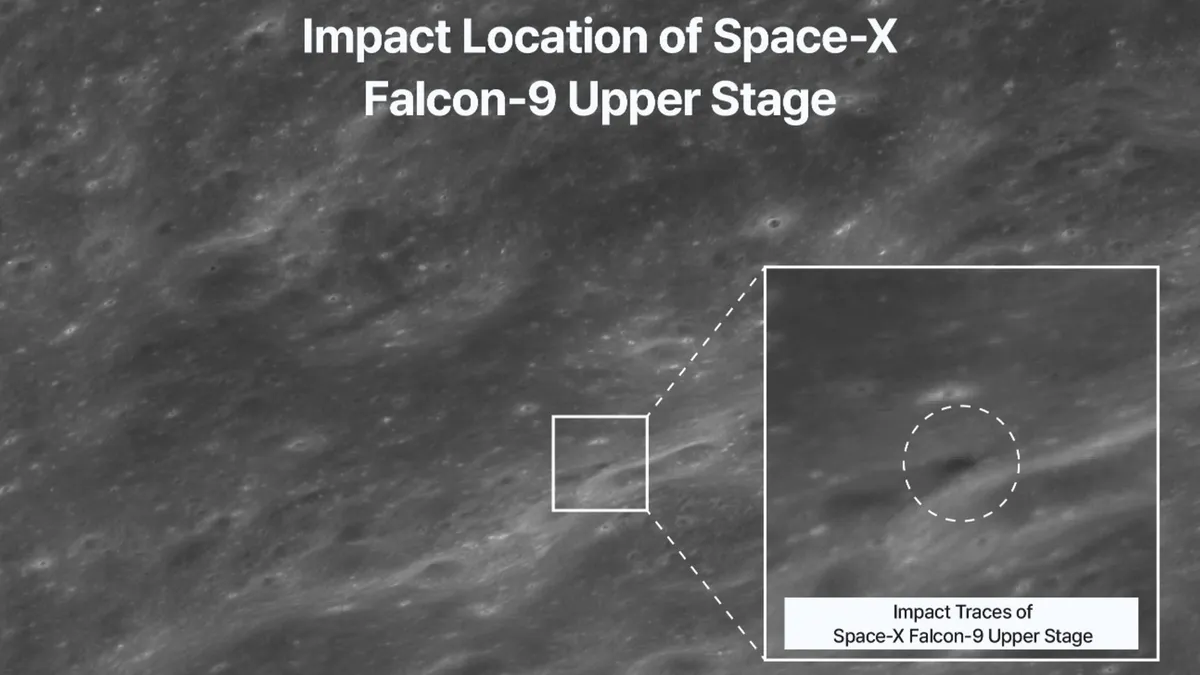
The moon is big. that it Surface areaIts area is about 14.7 million square miles (38 million square kilometers) and rivals the area of Asia, Earth’s largest continent, which covers 17 million square miles (44 million square kilometers). But the Moon’s low gravity — about 17 percent of Earth’s — means that the dust stirred up by the impact travels a long distance and takes a long time to settle, McDowell said.
“It’s not just a local event,” he added. “It is equivalent to a continental-level event. In the future, when you do that Permanent human bases For scientific experiments on the Moon, we do not want rocket stages to collide with the Moon on a regular basis, creating large plumes of dust that could contaminate instruments or disturb Gravitational wave Detectors.”
Furthermore, the artificial materials introduced and the craters created when heavy rocket stages collide with the lunar surface are altering the lunar environment, potentially wiping out as-yet-unexplored scientific material.
“The moon collides naturally Meteorites“These impacts form part of the geological record that scientists are trying to understand. The main concern is the changing physical and chemical environment of the Moon, especially where frequent perturbations could destroy or obscure valuable scientific evidence,” Lefort wrote.
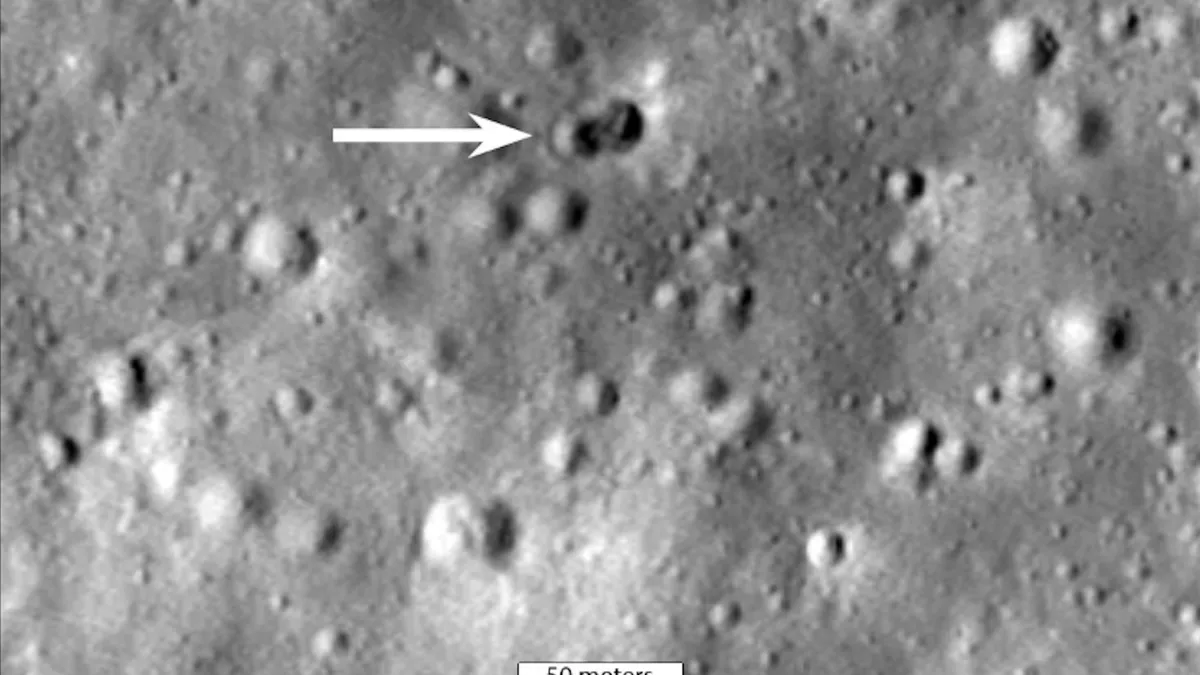
Gregory Radisic, a space law expert at Australia’s Bond University, told Space.com that the Falcon 9 crash is timely, because it could spark debate about responsible behavior in space before the moon gets too busy.
“It’s not through good planning that this didn’t amount to something important,” he said. “It is fortunate that we are only having a conversation about theoretical issues for the future and that this did not destroy a million-dollar experiment or an important site for scientific study.”
He added that spaceflight companies may only begin to care about risks after human lives are lost or expensive infrastructure suffers, leading to fines and tangible consequences.
“When there is a loss of life or a loss of investment, the industry will start to care,” Radisic said. “As long as objects lose their aesthetic or scientific value, industry is unlikely to care.”
The Falcon 9 rocket stage that struck the moon was left in high-altitude Earth orbit in January 2025, after it propelled the Firefly Aerospace spacecraft. Blue Ghost And Ispace Resilience Landing to the moon.
McDowell explained that since the rocket stage was left relatively close to the moon, this happened again Affected by lunar gravityand eventually mounts to its surface.
“If you leave [an object] In orbit located in this central region, it is far enough away that the Moon’s gravity affects it, but not far enough away to enter orbit around it The sun“This orbit is very difficult to predict,” McDowell said. “The orbital uncertainties multiply over many passes, and eventually, if you’re unlucky, the moon pulls it into an orbit where it will collide with either the moon or the Earth in a completely unpredictable way.”
Since its launch in January 2025, SpaceX has pushed its moon mission rockets farther into orbit around the sun, McDowell said.
“I hope that we will see a new modular development, and that what we have seen now will not be how you get rid of your rocket stages in the future,” he added.


