A rare lunar meteorite that has fallen to Earth bears evidence of a previously unknown “impact event” that rocked the moon about 3.5 billion years ago, researchers said. Studying this ancient effect provides new insight into how it happened Solar system He was acting in those early days – around the same time that life on Earth was beginning to emerge.
In the new study, scientists looked at a lunar meteorite found in northwest Africa. The meteorite, called NWA 12593, contains information about three separate impacts on the moon’s surface, but researchers focused on the oldest of these impacts, the team reported in the journal. Geology.
“On Earth, the first fossil evidence of life appeared about 3.5 billion years ago, meaning that life appeared and evolved before then,” Caroline CroweThe study’s first author, a planetary scientist at the University of Colorado Boulder, said V.A statement. “The question that often arises, even if we go back even further, is what was the impact record when life began to emerge? It is important for understanding how life takes hold… The cadence of these catastrophic events is an important part of the equation.”
In this study, scientists used radiometric dating of the meteorite. This method charts the decay rate of radioactive material in the sample, allowing the team to estimate the first impact 3.5 billion years ago, about a billion years after the solar system formed.
The meteorite contains cubic zirconia, known on Earth for its similarity to diamonds. But in the ancient meteorite, this material tells a different story: that the moon’s surface became molten through impact, because cubic zirconia only forms at extremely high temperatures. While the material dissipates at the frigid temperatures found on the Moon, scientists have detected its presence through traces of its recrystallized products.
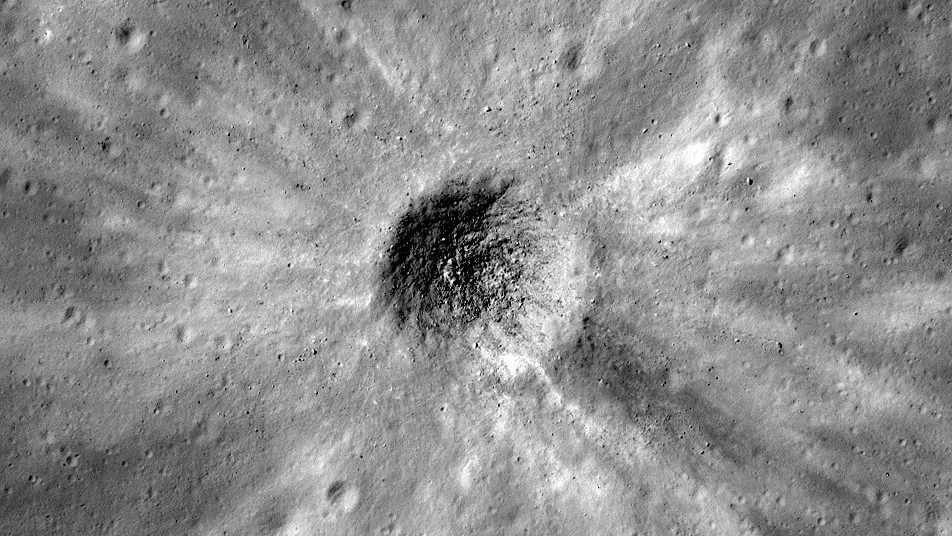
A large impact crater on the moon’s surface captured by NASA’s Lunar Reconnaissance Orbiter.
(Image credit: NASA/GSFC/Arizona State University)
The collision occurred at about the same time as other massive collisions, either on Earth or on a very large asteroid called Vistawhich were identified in independent research. It’s rare to find three impacts on three different worlds long ago, because erosion and other processes tend to erase evidence.
“It’s not very common, which is why we’re so excited about it,” Crowe said. “It’s very rare for the three records to line up like this.” The team expects that deeper comparisons between impacts will reveal more about how the solar system changed 3.5 billion years ago, as the number of asteroids in the region diminished along with the impacts.
Get the world’s most incredible discoveries delivered straight to your inbox.
Scientists often say that the early solar system was a collection of gases and dust that gradually grew into smaller bodies resembling comets and asteroids. Over time, a subset of those objects became larger (through collisions and accretions) to become today’s planets and moons.
The other two impacts on the meteorite were breccia (melting rock) that formed after the great impact 3.5 billion years ago, and a third impact that sent the meteorite flying from the Moon onto a path toward Earth.
Crow, C. A., Erickson, T. M., Economos, R., Lehman-Franco, K., Boyce, J. W., Richards, A. M., Diaz, C. A., Flowers, R. M., Bronce, M., Schoene, B., & Benowitz, J. A. (2026). Three-body evidence of ca. 3.7G to 3.2G bombardment across the inner solar system. Geology. https://doi.org/10.1130/g54386.1
How much do you know about the moon? Test your lunar intelligence with our partners Moon Contest!